Forest Thinning
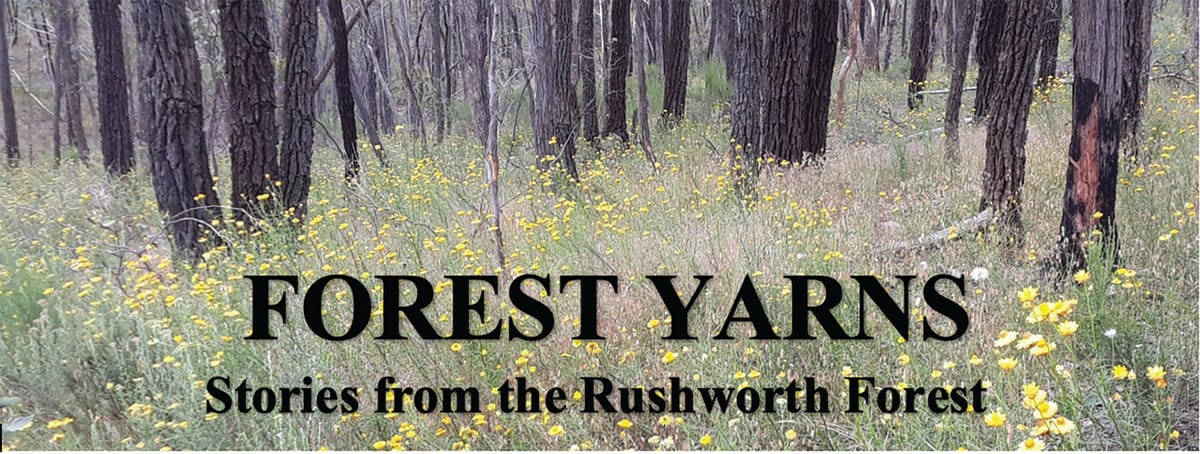
By the early 1900s, one of the government practices that regularly took place in the Rushworth forest was the “thinning” of forest. It was recognised that there had been significant change to the forest in the previous 50 years, and thinning was at the time deemed to be best practice to restore the forest, as well as ensure an ongoing supply of suitable timber.
Part of the push for forest thinning came from the Conservator of Victorian Forests, George Perrin. In a report to the Royal Commission into Victorian forests, which included a review of the ways in which conservation and management could be improved, Perrin noted that “Many excellent suggestions are embodied in the foresters’ annual reports for the year. They are nearly all unanimous in recommending the continuance of forest thinning, especially in the redgum areas on the Murray and Goulburn rivers, and the valuable young ironbark forests now to be found in so many parts of the colony, and upon which our national railway system will have to depend almost exclusively for suitable supplies of sleepers. Money expended in forest thinning is, in my opinion, money well laid out. In addition to giving temporary employment and thereby relieving our congested labour market, the removal, under trained supervision, of all stunted and surplus growth has a remarkably beneficial effect upon forests of young indigenous timber.”1
Perrin also noted in his report that the Rushworth-Heathcote state forests would be the first to trial a scheme in which royalties would be charged on all products removed from the forest.
Implementing Recommendations
The recommendations of the Royal Commission did much to determine the nature of the works carried out in the Rushworth forest in subsequent years. A few years later, an article that appeared in the Melbourne “Age” newspaper clearly outlining its impact on forestry practices in the Waranga area, viz.
“The thinning out and cleaning up of the State ironbark forest in the vicinity of Rushworth and Whroo, which was entrusted to the unemployed from Melbourne, in conjunction with a batch of local unemployed, who are expert woodsmen, under the direction of Mr Alex Spence, has advanced considerably. Quite a transformation has been effected.
The useless crooked timber, fallen trees and bush tops, stumps, scrub and matted undergrowth have all been removed. All the timber that is suitable for firewood has been cut into short lengths and neatly piled, whilst the useless stuff has been burnt. Those portions of the forest already cleared present the appearance of a well-kept park.
The trees that remain are as straight as a rush, and have been trimmed where required, and in years to come the forest, which has already yielded thousands of pounds worth of timber, should prove of great value as a source of revenue to the Lands Department.
The timber that has been cut in the clearing process will go a long way towards defraying the cost of the work. There are some hundreds of tons of 2 feet ironbark firewood, whilst the box timber has been cut into sawmill lengths, and there are over 70 truckloads cut. In addition to the firewood a large quantity of electric light poles, for which 6/- (60c) each are paid, have been cut and were trucked (ed. by rail) to Melbourne last week. These sticks were taken because they were in excess of the proper number of trees to the acre. Nearly 700 acres have been cleared up to the present.”2
It would be interesting to know what was deemed to be the “proper number of trees to the acre” at the time, and how that compares with what we see in the forest today.
Funding Shortfalls
As with any government financed activities, there was often a shortfall in the funds required to maintain forests. Occasionally, specific purpose funding was made available. For instance, in 1906 “Steps are again being taken by the Forestry Department with a view to the eradication of the parasite known as “Mistletoe,” which is so prevalent amongst the ironbark forest in this district. Local gangs will be put on next week, but the more extensive scheme of forest thinning and eradication proposed in the Moormbool (i.e. Rushworth) forest will not be proceeded with until the settlement areas to be thrown open for selection have been decided upon.”3 At the time there was pressure to make more land on the fringes of the forest available for selection, despite the fact that this was generally very marginal land.
Over twenty years later, in the mid-1920s, forests staff were still lamenting the lack of funds available for thinning of forests in accordance with the prevailing views of the day.
References: 1 The Bacchus Marsh Express 22.4.1899; 2 The Age 5/8/1903; 3 Hobart Mercury 20.6.1906