Fire in the forest
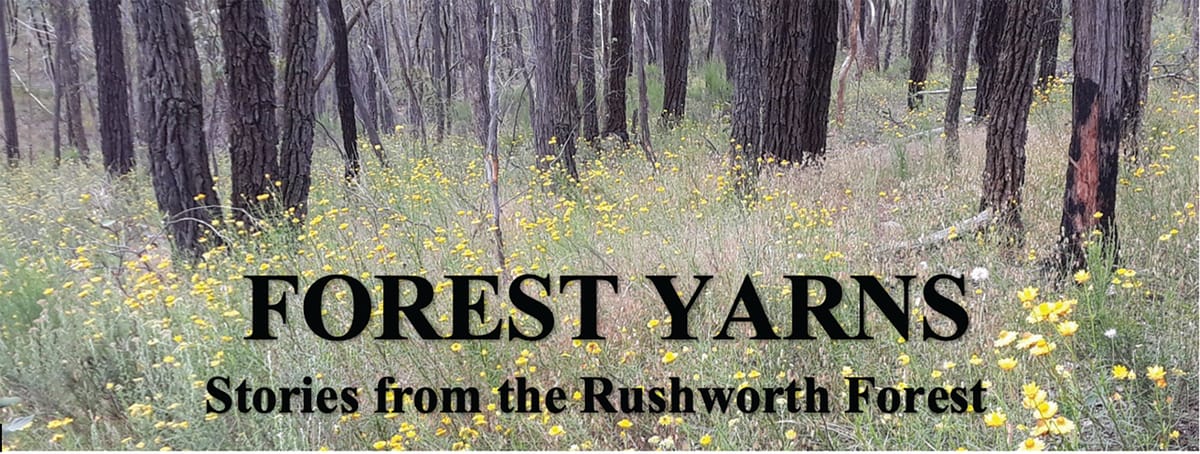
Over the years, the Rushworth forest has thankfully been spared from a major conflagration. One of the reasons might be that box ironbark forests are less susceptible to big fires than other forest types. The main species of trees do not shed their bark each year, leading to a build-up of fuel that can be found in other areas. The understorey of box-ironbark forests is also limited, compared to other forest types.
Evidence suggests that most wildfires on public land across the box-ironbark forests are small. “For example, between 1980/81 and 1995/96, almost 80% of the 800 wildfires recorded on public land across the Box-Ironbark region were less than 5 ha in size, and only around 15 exceeded 100 ha.”1
However, there is no room for complacency. It would seem that the danger is increasing in the local area due to the hotter weather conditions that have been experienced in recent decades.
1939 Fire Season
Not much seems to have been documented about the history of fires in the Rushworth forest until the advent of Forests Commission Victoria (FCV) meant that more records were prepared. The 1938-9 fire season was one of the worst on record. The seriousness of these fires prompted the FCV to get its staff in each region of Victoria to prepare a report on what had happened locally. Nicholas Power was the responsible officer for the Rushworth area, and his report is held by the Public Records Office.2
Power reported on three small fires in Whroo and Moora in December 1938, including one on Christmas Day, but none of these burnt more than 3 acres (1.2 ha). Some of the staff who attended these fires included Foreman J J Hageman and Leading Hand R Pettifer. There were ominous signs when a larger fire broke out near Moora, in the parish of Whroo, a week before Christmas. The area had been thinned by FCV staff just three years earlier, but it still burned strongly. It turned out to be the largest local forest fire that summer, at 33.5 acres (14 hectares).
Black Friday
13 January 1939 became known in Victoria as Black Friday. It is often likened to the dramatic fires of 1983 and 2009 which devastated large parts of the state. FCV Officer Power reported the weather was extreme – the day was “the worst in history” for fire danger, with temperatures of 113 degrees Fahrenheit (45 degrees Celsius) with the wind blowing 60 miles per hour (100 kph). A fire started at Bailieston in the parish of Wirrate, with the cause unknown. The FCV were notified by a sleeper hewer working in the area at the time. You would have to question why someone would be working cutting sleepers in those conditions!
Power suspected that the fire may have started from a smouldering underground root still alight from burning off operations in September 1938. You would think a fire would be unstoppable given the weather conditions, but the seven brave FCV staff managed to contain the fire to 16 acres (6.5 ha). The rest of the state was not so lucky. Two million hectares (4.9 m acres) were burnt, 71 people died and 650 structures were destroyed.
In the wake of the 1939 fires, no money was available for work in the Rushworth forest as all available funds were directed towards the restoration of large areas of Gippsland forests.
Humans at fault
Sadly, Power’s reports indicate that few, if any, of the fires were the result of natural causes. He postulated that the causes included deliberate lighting of some of the fires, and carelessness in other cases. The Christmas Day fire near Whroo appeared to be one of the former, and Power initiated extra patrols by his men to try to stop the practice in its tracks. There had been other suspicious fires in the locality. The suspected culprit in that case was a Whroo resident who had recently been released from a mental institution but he was later exonerated.
In 1941 Power was a prosecution witness in a case where the defendant was fined 20 pounds ($40) for deliberately lighting two fires south of Whroo. Shortly beforehand, Power had denied one George Mason a licence to cut sleepers in the forest. The fires were lit, perhaps in retribution, as the defendant was riding his bicycle south to Bailieston after consuming 25-30 pots (his own estimate) at Rushworth hotels. It was a wonder he could ride at all, let alone commit arson.
References: 1 DSE Ecological Burning in Box-Ironbark Forests – Phase 1 Literature Review (2007); 2 PROV, FCV File No 38/3576