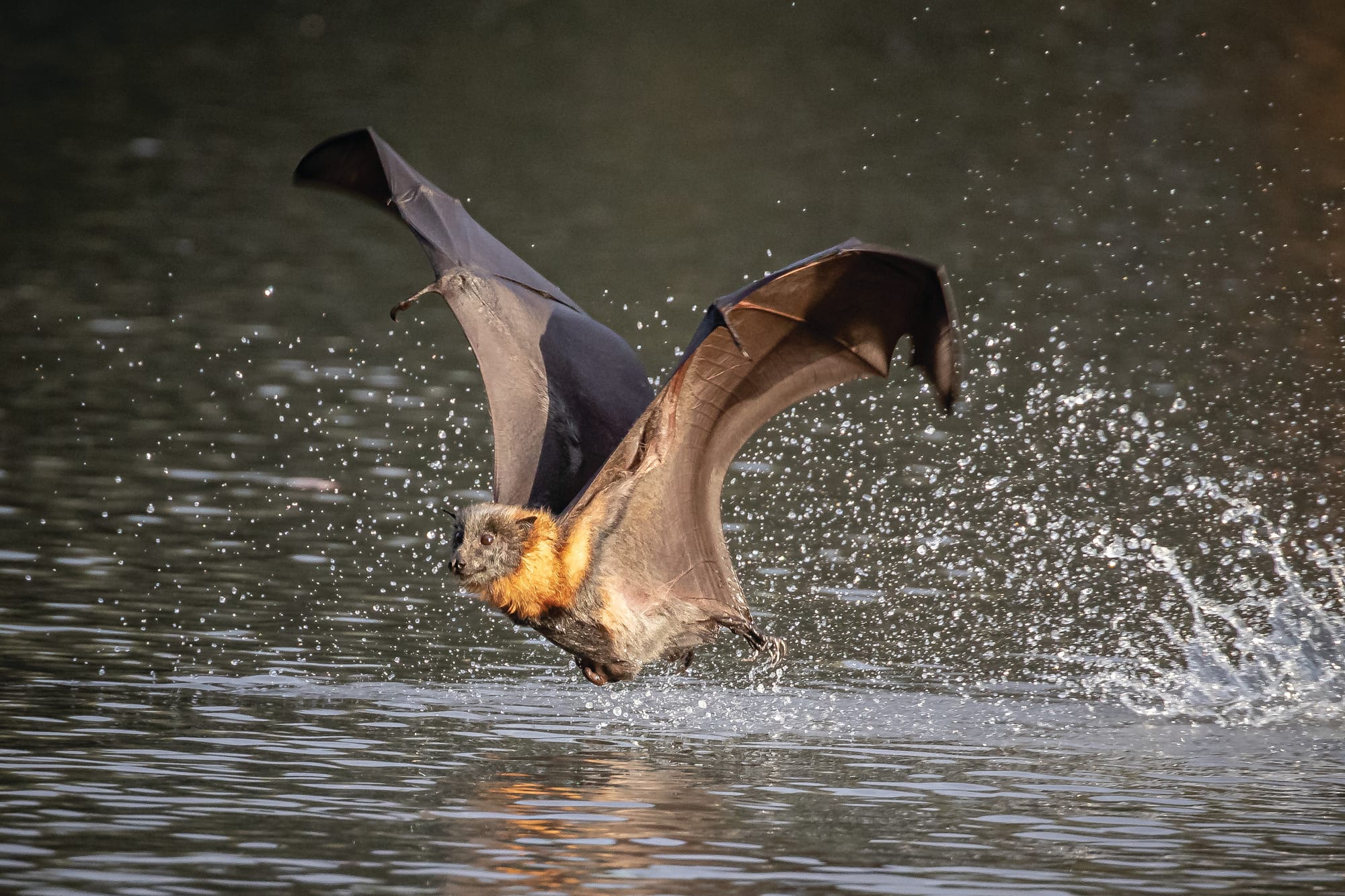
Grey-headed Flying Fox
Apart from birds, there is only one other animal who has evolved independent flight with wings....the bat.
Grey-headed Flying Foxes are our largest species of bat in Australia and we are lucky enough to have them in Northern Victoria.
We currently have two major colonies, one being at Numurkah and another at Tatura.
The Numurkah colony has been along the Broken Creek for many years. The Tatura colony popped up after the establishment of the Numurkah colony and now we have smaller colonies popping up in places like Echuca and Tocumwal.
Deb and I have monitored the Numurkah colony for close to twenty years. Each season we keep an eye on the large colony which resides along the banks of the Broken Creek right in town. The primary concern for the bats is extreme heat events, namely when we have days which are over 38 degrees, although sudden temperature fluctuations from cold to hot and vice versa are also an issue for these animals.
The first heat event in January saw temperatures climb and with accompanying hot gale force winds, that was the week the Longwood fire and other significant fires around the state ignited. Due to the chaos of the fires, keeping our own critters at the shelter cool enough to avoid losses in our care, both Deb and I failed to get out to the Numurkah or Tatura colony.
On the Thursday night of that first heat event week, I was alerted that the bats were in trouble at Numurkah and I needed to get out there as soon as possible.
I did and was sobered by the amount of lifeless bodies amongst the colony. We lost at least 200 bats, a mixture of adults and young alike. One of our volunteers, Tanya, my son Daniel and I worked late into the night piling up and counting the dead and we brought a total of seven bats back home into care for rehydration and rest. These bats were able to be released a few days later after the heat subsided. We did not arrive back at the shelter until well after midnight.
With the following day set to reach temperatures of 46℃, we hatched a plan to be out in the colony to help mitigate the heat stress for the poor bats.
When flying foxes become heat stressed, they begin to clump together in small, tight groups up the top of their roost trees. As the heat and stress progress, these smaller clumps begin forming massive clumps of heat stressed bats and we know that when these large masses of bats begin to travel down the tree trunks to the ground, this is when we have mass death of bats on the ground at the base of trees.
Why do they do this?
Scientifically, we still do not know. Clumping doesn’t actually cool the bats down and may even make them hotter, so we don’t understand the reasoning for this behaviour.
We do know that if we spray the bats as they begin coming down in these heat stressed clumps, we save lives. Spraying cools them, also gives them rehydration at the same time as they lick water from the fur and wings of themselves and each other. Once the clumps cool down enough, they disperse again and scatter out, then the entire process keeps going all day, all through the colony.
When we are there to spray, we have minimal to no losses, but it’s a hard, hot gig, being sure to keep ourselves hydrated and sprayed down to be able to function out in the heat and terrain of the bat camp.
Our colony at Numurkah consists of predominantly Grey-headed Flying Foxes but also has a smaller number of Little Red Flying Foxes. Little Reds are more nomadic and generally stay in the colony for up to five weeks or so before disappearing for awhile, then returning a few weeks later.
The number in both the Tatura and Numurkah colony fluctuate greatly throughout the year but from the birth of the first pups around October, the colonies are generally quite large as the babes are initially carried by mother bat until they become too heavy, after which the pups remain camped in the creche of the colony until they too are mature enough to fly out and forage for food at nightfall.
Despite the horrific heat that Friday, a small handful of us managed to keep the bats cool enough to make it through, as we did the following heat event a couple of weeks later when we had a full week of over 40 temps.
Grey-headed flying foxes are endangered in Victoria and are a keystone species for pollination of our bushland. These bats can fly up to distances of 50km a night, spreading pollen and seeds for many miles.
They are highly social creatures, intelligent and are hugely misunderstood.
Less than 1% of Australian bats carry the Lyssa Virus, which can be fatal to humans and can only be contracted by a bite or scratch from an infected bat as it is contracted through the saliva of bats. Lyssa is basically our strain of rabies in Australia. For this reason, we ask people not to touch or pick up injured or sick bats as our volunteers are vaccinated for this.
We cannot catch any other disease directly from the bats, so you are not in any danger from bats if they reside in your garden or you live close to one of our colonies.
If you find a bat needing help, please call your local wildlife rescue service for assistance and advice.
When we are out at the colonies keeping the bats cool, our aim is to stop colony collapse, which has happened this season down in Melbourne colonies when they’ve experienced even one day of extreme heat, with thousands of bats dying.
Climate change is a real threat to these unique creatures and we are starting to put plans in place to improve the habitat of the colonies as this will go a long way to help them keep cool. When vegetation is not as it should be due to clearing and degradation, the colonies find it more difficult to keep cool.
Time and time again, it is the same story for many of our wild creatures. Habitat loss is the number one driver of localised extinctions. Without habitat for shelter, food and raising young, dwindling numbers of many species struggle even more in the face of other threats such as climate change, introduced predators and human activities.
I am very proud of our small band of volunteers who continue to keep these important colonies from crashing.
Thank you to Deb, Tanya, Kylie, Maggie, Ashley, Emily, Daniel and Odin for all working in horrendous conditions to help prevent colony collapse at both our Numurkah and Tatura colonies.
I was not out at Tatura colony as Deb took control of our efforts out there while I looked after our Numurkah bats. Tatura lost around 700 bats those first couple of days before we were alerted and Deb and our volunteers got out there. In both colonies, while we were out there spraying, we had minimal to no losses. Without help, both colonies would have been in serious jeopardy of complete colony collapse.
We can make a difference.